The steps below describe our proposed working approach. Your approved proposal and project agreement determine the actual deliverables, timeline, fees, review points, and support commitments. Some stages may be combined for smaller projects.
Phase 1 / DISCOVER — Understand before building
01. Start a conversation
Tell us what your business does, what you need, who will use it, and what is not working today. You can begin with a simple explanation; technical documents are not required for the first inquiry.
Helpful details: your business type, audience, primary goal, existing website or app, required platforms, desired features, approximate budget, and target date (if any). Sharing a date does not mean it has been accepted as a delivery deadline.
Next step: We review the inquiry for fit and identify which questions must be answered before an estimate is reliable.
02. Discover the real requirements
We clarify the user journeys and business processes the solution must support. For example, a resort website may need attractive room pages; a reservation system also needs reliable availability, pricing rules, confirmation, cancellations, and staff access. They are different scopes.
We explore:
- Main user groups, goals, and success measures.
- Must-have features versus useful future enhancements.
- Content, brand assets, languages, accessibility expectations, and search visibility.
- Integrations with payment, booking, email, SMS, maps, existing databases, or third-party services.
- Security, privacy, data sensitivity, legal or industry-specific requirements.
- Technical constraints, account ownership, operating costs, and ongoing support.
Working output: a clarified project brief, assumptions, early risks, and a practical first-release recommendation where appropriate.
Phase 2 / PLAN — Agree on the work
03. Define the scope and proposal
After discovery, we prepare a proposal appropriate to the project’s complexity. It should explain the agreed objectives; features and deliverables; pages, screens, user roles, and integrations; content responsibilities; assumptions and exclusions; estimated milestones; reviews; testing and acceptance; third-party expenses; payment schedule; and ownership/handover conditions.
For a complex system, we may recommend a separately scoped planning or prototype phase before estimating the full build. We do not treat an inquiry or an early estimate as an automatically binding order.
Decision point: We proceed only after both sides approve the agreed scope and commercial terms.
04. Map the experience and confirm the design direction
Depending on scope, we organize the site map, user journeys, wireframes, mockups, content structure, and visual direction. For a store this may include browsing and checkout; for a dashboard, roles and data views; for a mobile app, onboarding, navigation, and device-specific interactions.
Client feedback at agreed checkpoints keeps the project aligned. A visual approval confirms a design direction; it does not silently add features or replace final functional testing.
Working output: reviewed layouts or prototypes and a prioritized build plan.
Phase 3 / BUILD & VERIFY — Create and validate
05. Develop in controlled increments
We implement the agreed functionality and review working portions of the product as the project progresses. The approach may be milestone-based for small websites or iterative for larger applications.
Development may include a content-management interface, database and roles, third-party integrations, administrative tools, payment or booking connections, and optional AI. These are provided only where explicitly agreed. Real-time booking, payment, and account actions require verified backend logic; an AI assistant must not invent an availability result, transaction, or confirmation.
Working output: demonstrable features with tracked questions, decisions, and issues.
06. Review progress and manage changes
At scheduled review points, the client compares the work with the approved scope. We record feedback, clarify unresolved questions, and decide whether requested changes fit within the agreement or require revised cost and schedule approval.
A change request is not automatically included. Additional pages, integrations, languages, redesigns, and functionality are evaluated before they are added to the agreed plan.
07. Test, correct, and seek acceptance
Before release, we assess the agreed user journeys and relevant quality risks. Depending on the project, this may include:
- Functional testing of forms, buttons, navigation, authentication, and business rules.
- Responsive layout checks on representative screen sizes, devices, and browsers.
- Accessibility checks appropriate to scope, using WCAG guidance as a reference.
- Security checks proportionate to risk, using OWASP guidance where applicable.
- Performance and page-experience reviews, including relevant Core Web Vitals.
- Basic SEO setup and metadata checks where purchased or included.
- Integration tests, error handling, and backups/restore checks where applicable.
- Client user-acceptance testing against explicitly agreed acceptance criteria.
The client checks final copy, pricing, product or legal content, and operational rules. Issues are recorded and prioritized before release. No software is represented as bug-free or universally secure.
Decision point: launch only after the agreed release criteria and approvals are satisfied.
Phase 4 / LAUNCH & CARE — Deliver responsibly
08. Prepare and complete the launch
We confirm domain and DNS access, hosting or cloud environment, SSL/TLS setup, production credentials, required backups, analytics configuration if approved, and any third-party subscription or app-store requirements. We define a release plan and, where appropriate, a rollback approach.
For a mobile app, store review and approval depend on the relevant platform and are not controlled by the studio. Launch tasks and third-party fees must be included or excluded explicitly in the agreement.
09. Handover with clear ownership
The handover follows the contract and may include agreed account access, operational instructions, documentation, repository access or code deliverables, content-editing guidance, admin training, and a list of subscriptions or renewal responsibilities.
Important: domain names, hosting accounts, app-store accounts, paid plugins, source code, design files, databases, and licenses are different assets. The agreement defines who owns each, what access is transferred, and which third-party terms still apply.
10. Maintain, improve, or hand over ongoing operations
A website or app still needs care after publication. Optional plans may cover updates, security patches, backups, monitoring, content edits, technical support, or new features, but their response hours, exclusions, and costs must be written down. Hosting, maintenance, new development, and emergency support are not necessarily one package.
If the client manages operations elsewhere, we agree on an appropriate handover and any transition assistance. Any defect-remediation period or warranty is defined separately in the agreement.
How the process changes by project type
| Project | Extra planning and verification needs |
|---|---|
| Business website | Page structure, content, calls to action, mobile use, contact form, SEO essentials |
| Online store | Product data, taxes/shipping rules, checkout provider, refunds, order notifications and roles |
| Booking website | Inventory or appointment rules, availability, time zones, cancellation rules and confirmations |
| Custom web system | Permissions, audit trails, migrations, reports, backups, acceptance cases and data protection |
| Mobile application | Android/iOS device coverage, platform accounts, permissions, store compliance and release review |
| Optional AI integration | Approved knowledge, provider costs, privacy, fallback paths, hallucination testing and authorized actions |
Project roadmaps
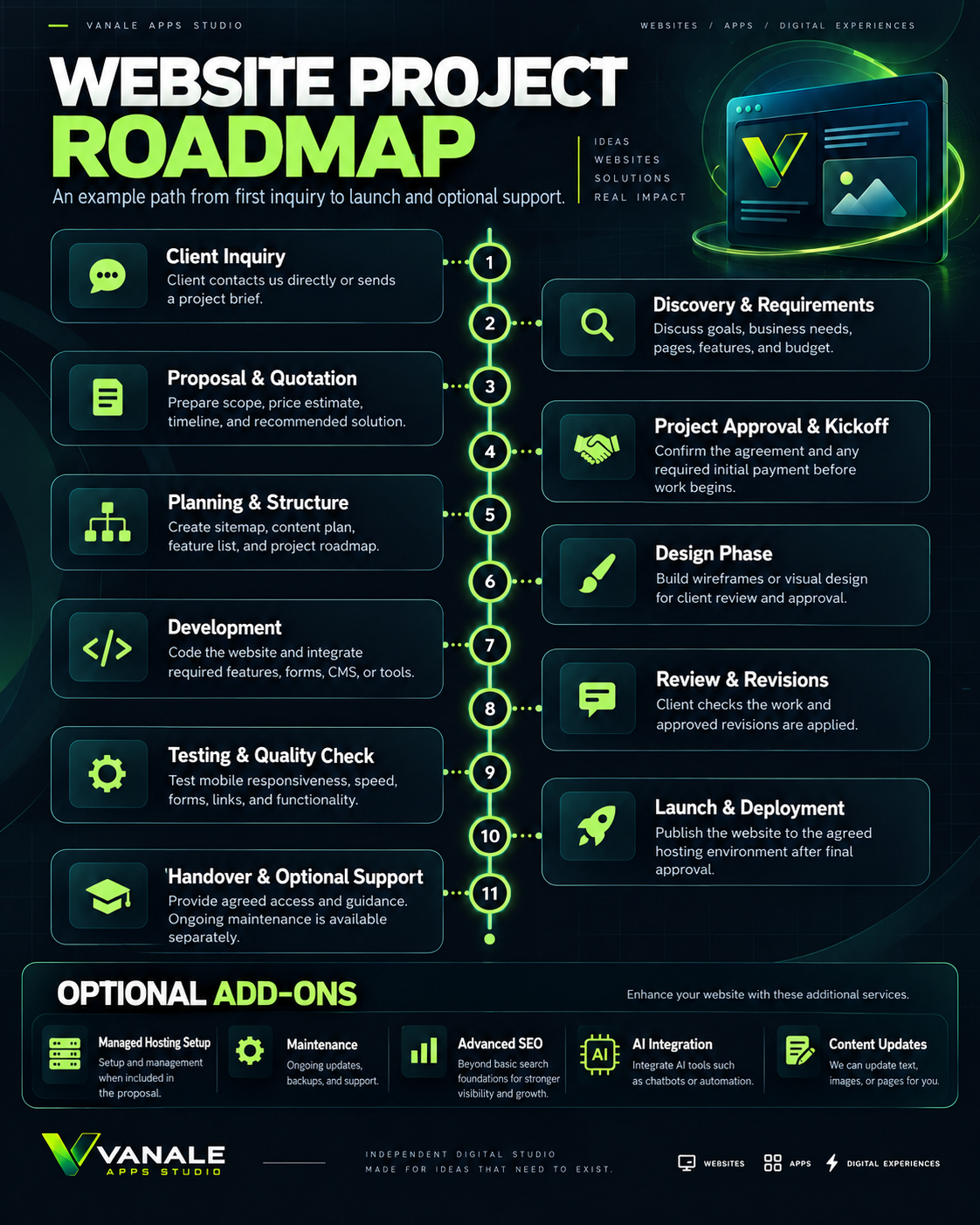
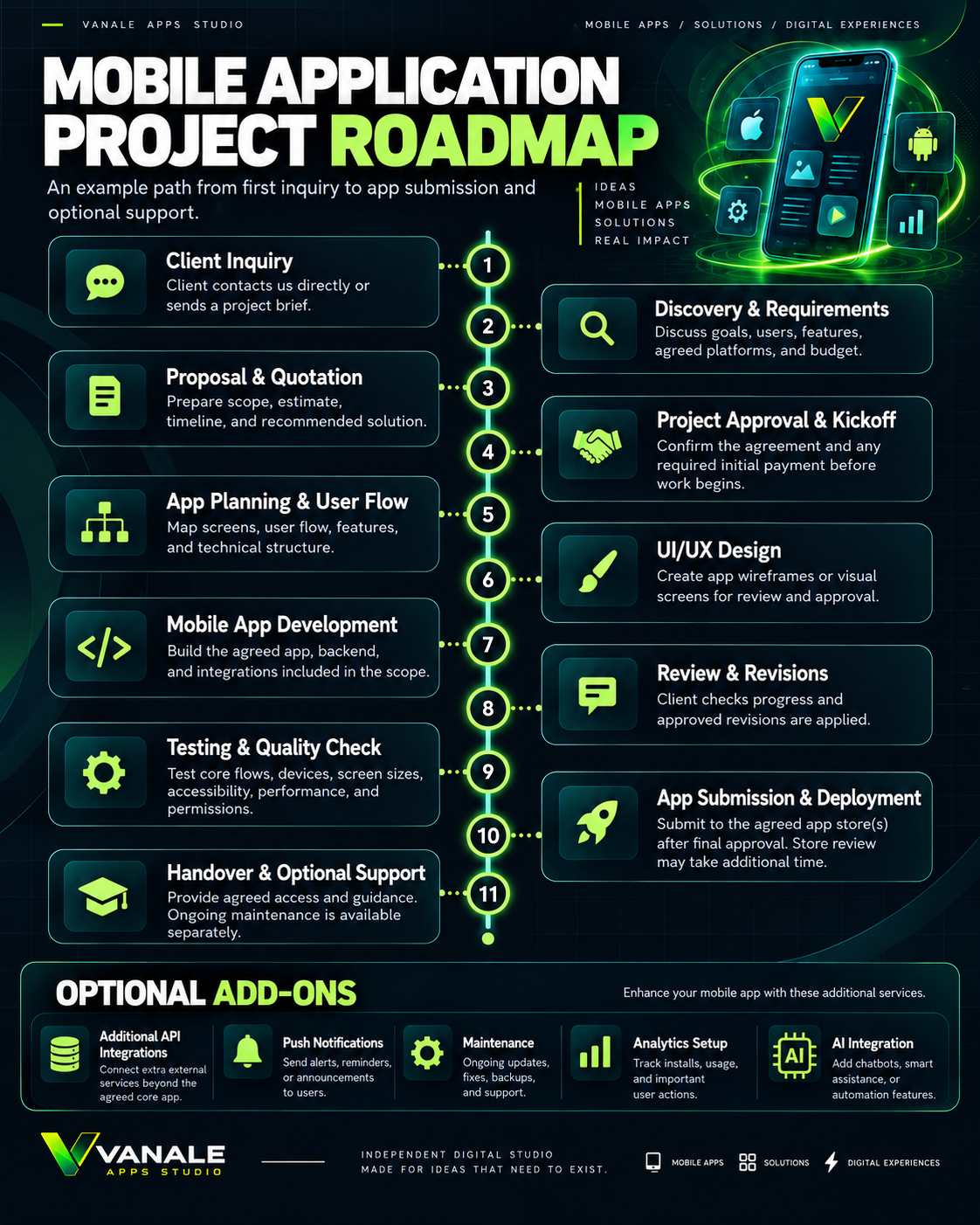
See an example path for a website or mobile app. The approved proposal determines the actual work, platforms, fees, and support.
Read the roadmap steps as text
Steps in this example
- Client Inquiry
Client contacts us directly or sends a project brief.
- Discovery & Requirements
Discuss goals, business needs, pages, features, and budget.
- Proposal & Quotation
Prepare scope, price estimate, timeline, and recommended solution.
- Project Approval & Kickoff
Confirm the agreement and any required initial payment before work begins.
- Planning & Structure
Create sitemap, content plan, feature list, and project roadmap.
- Design Phase
Build wireframes or visual design for client review and approval.
- Development
Code the website and integrate required features, forms, CMS, or tools.
- Review & Revisions
Client checks the work and approved revisions are applied.
- Testing & Quality Check
Test mobile responsiveness, speed, forms, links, and functionality.
- Launch & Deployment
Publish the website to the agreed hosting environment after final approval.
- Handover & Optional Support
Provide agreed access and guidance. Ongoing maintenance is available separately.
Possible add-ons
These are discussed and priced according to the agreed scope.
- Managed Hosting SetupSetup and management when included in the proposal.
- MaintenanceOngoing updates, backups, and support.
- Advanced SEOBeyond basic search foundations for stronger visibility and growth.
- AI IntegrationIntegrate AI tools such as chatbots or automation.
- Content UpdatesWe can update text, images, or pages for you.
Read the roadmap steps as text
Steps in this example
- Client Inquiry
Client contacts us directly or sends a project brief.
- Discovery & Requirements
Discuss goals, users, features, agreed platforms, and budget.
- Proposal & Quotation
Prepare scope, estimate, timeline, and recommended solution.
- Project Approval & Kickoff
Confirm the agreement and any required initial payment before work begins.
- App Planning & User Flow
Map screens, user flow, features, and technical structure.
- UI/UX Design
Create app wireframes or visual screens for review and approval.
- Mobile App Development
Build the agreed app, backend, and integrations included in the scope.
- Review & Revisions
Client checks progress and approved revisions are applied.
- Testing & Quality Check
Test core flows, devices, screen sizes, accessibility, performance, and permissions.
- App Submission & Deployment
Submit to the agreed app store(s) after final approval. Store review may take additional time.
- Handover & Optional Support
Provide agreed access and guidance. Ongoing maintenance is available separately.
Possible add-ons
These are discussed and priced according to the agreed scope.
- Additional API IntegrationsConnect extra external services beyond the agreed core app.
- Push NotificationsSend alerts, reminders, or announcements to users.
- MaintenanceOngoing updates, fixes, backups, and support.
- Analytics SetupTrack installs, usage, and important user actions.
- AI IntegrationAdd chatbots, smart assistance, or automation features.
What helps keep projects on track?
From the client: one designated decision-maker; accurate requirements; rights to supplied materials; timely content and feedback; access to relevant service accounts; and approval of business rules, legal text, and final release.
From the studio, where agreed: a documented plan and scope; explained assumptions; visible review points; issue tracking; an agreed route for changes; proportionate QA; and a handover matched to the purchased deliverables.
Frequently asked questions
Do I need technical knowledge to begin? No. Describe the problem and the result you want; we can explore an appropriate solution together.
Can I request a free estimate? You can send a project inquiry without making a purchase. Whether detailed technical discovery or a prototype requires a separate fee will be explained before any paid work.
Can you build from an existing website? We can evaluate a redesign, migration, integration, or rebuild. Access, licensing, security, and data-backup risks must be reviewed first.
Can I ask for changes during development? Yes. Requests are evaluated against the approved scope; changes to cost or timing need agreement before implementation.
Is AI part of every project? No. AI is optional and will be considered only where it offers a useful fit. It also brings ongoing provider costs and safeguards.
Is hosting included? Not automatically. The proposal identifies domain, hosting, third-party subscriptions, renewals, and who pays for each.
Will I receive source code or own the app? Your agreement specifies ownership, licenses, code delivery, repository access, and third-party restrictions. Do not assume the same rule applies to every project.
Are revisions, fixes, and maintenance unlimited? No. Revision rounds, acceptance, any defect-remediation terms, and ongoing support depend on the agreed contract.
Are the Work samples paid client projects? No. The Work area is for clearly labeled sample concepts, with no public working previews listed yet. Our studio-owned products are separate from client commissions.